• Home
  • Models
  • Partnering
  • Design
  • Executive Summary
  • Home
  • Models
  • Partnering
  • Design
  • Executive Summary

MODEL PLANS

Technical drawing of a bicycle with measurements and seat height options.

Plans and Directions

Simple Cycle models include Bicycles, Tricycles, Kick-bikes and Handcycles.


All models are DIY do-it-yourself owner-buildable.


Each set of Plans details how to build 1 model.


Models evolve over generations; photos on these pages may show earlier versions.

Complexity

The complexity of builds is designated as either ‘Simple’, ‘Simpler’ or ‘Simplest’. This rating is determined primarily by the type of transmission.

        ◦ ‘Simple’ models require that the builder acquire a group of standard bike transmission parts – sprocket, chain, crankset and bearings – and have access to one or more specialized bike tools. This is the Bike-in-a-Bucket building approach to be used by large organizations. 

        ◦ ‘Simpler’ models require purchase or salvage of one or two commercial bike components. They may require also that one or more small pieces of metal be cut (a couple of minutes each using a hacksaw) and drilled. In order to avoid the high cost of an imported crankset, making a homemade crankset requires that you locate a person or shop who can take a few minutes to weld together the small metal pieces that you have hacksawed to length. This is the Bike-in-a-Shoe-box approach. 

        ◦ ‘Simplest’ models need no purchased bike components, have the fewest and least complex pieces to be cut and drilled, require the very fewest tools, need no welding at all, and are therefore most fully owner-buildable and lowest cost. 

Pre-Ordering of Plans

    • You can pre-order and pay now for Plans for any of these models, even if Plans for the model you want to build are not yet complete and available for download. 

    • Pre-orders serve to inform us of the relative popularity of each model. Those models with the largest number of pre-orders will become our highest development priority.

    • If you choose to pre-order Plans for a not-yet-available model, you later will be able to download your already-paid-for Plans at any time after they are posted online. 

    • Pre-orders assist us in building the Simple Cycle Project, by helping to pay the up-front costs of each model’s development as those costs are incurred. 

    • You may choose to advance the Project’s development by placing multiple pre-orders. If doing so makes sense for your situation, you can estimate the number of people you are trying to help obtain a cycle, and then pre-order for each of them.  Each pre-order serves as a ‘vote’ for quicker development of the particular model(s) in which you (and your clientele) have the most interest. 

    • Each pre-order accelerates our development, and brings closer the day when those whom we seek to help will have a cycle to use. We are aiming to have the first Plans available by Q3, 2026.

MODELS

Models are introduced on this page in an order which roughly reflects the present completeness of their development. This sequence will change as the arrival of pre-orders influences our priorities.


We are aiming to have the first few model Plans completed and posted in Quarter 3 of 2026. 

Kiki

Complexity: Simplest. 

Tools needed: Wood-saw, hand-drill, drill bit for wood, adjustable wrench.

Purchased or salvaged components: tires and tubes or rubber tread, metal tube or long bolt for pivot-pin, fasteners (bolts, screws or nails).

Materials: 3 sizes of dimension lumber (two-by-four, two-by-six, one-by-six)


For whom is the Kiki designed? This general-purpose ‘kick-bike’ (also known as a “foot-bike”, “pushbike” or “kick-scooter”) is designed for those who need the simplest possible bike-building project. The Kiki is also for those who cannot obtain or afford the group of components which are needed for a chain-drive transmission. The Kiki serves persons who prefer standing-and-kicking over pedaling-while-seated. It can serve well those persons who commute shorter distances to school or work, who do not have a need for large cargo capacity. 


Who should not get the Kiki? Those who need the very highest efficiency and fastest cruising speed for long, level distances, and who also can afford and obtain parts for a crankset/pedal/chain transmission.


Whom does the Kiki fit? Seat and handlebar positions are highly adjustable; it best fits petite and large adults from 5’2” (155 cm) to 6’4” (195 cm). Handlebar placement is widely adjustable; the bars (your choice of straight or swept) can be moved up and down the fork legs and can be attached to front or back of the fork legs for your preferred amount of reach, as well as being blocked even more forward or further back using spacer blocks held on with longer bolts.


What is the Kiki’s cargo capacity? Can accommodate a fork-mounted front basket above the front wheel. Supports can be attached to the front fork to support and stabilize oversize front panniers or baskets. The optional front Rhino Rack requires some extra work and precise fabrication but supports 16” of valuable cargo space above the front wheel (it displaces any fork-mounted front basket) where the rack does not move with steering motions and is therefore easy to balance if heavily loaded. This front load is directly observable at all times – making it a good spot for pets and other small live creatures who need monitoring. The lack of side-to-side steering movement is an advantage for creatures that don’t tolerate vertigo and ‘car-sickness’.


What is the Kiki’s outstanding capability? Despite having no transmission, a rider with experience can achieve in average conditions approximately 70% the speed and daily range of a pedal bike. The low deck and large front wheel make balance and steering easy. The large wheels increase rolling efficiency on non-paved surfaces. It handles most roads and paths, except those with lots of cobbles and rocks. It is great on paved bike paths. It is an efficient climber and fast descender. The Kiki is a good commuter bike on city streets for most adults. With the rider’s head at full standing height, with eyes forward and head free to swivel, it has both good rider-to-car and car-to-rider awareness in mixed pedestrian or auto traffic. It is generally easy on the body, and we have found its ergonomics a good antidote to long hours spent sitting in an office chair or classroom seat. 


What options will it accommodate? The Kiki will accommodate as front or rear wheel almost any after-market electric hub-motor assist kit that has a throttle. A clip-on over-the-shoulder carrying strap can be made for carrying it up stairs or rocky trails.


What are its limitations? With its necessarily-low deck height (that makes kicking efficient), you have to be observant and careful when riding through puddles, going over curbs or riding rocky paths. It will not fit some car bike-racks. Brute weight-carrying capacity is less than that of the Kudu.


What components will the Kiki accept? 26” front wheel and 20” rear wheel, with 2”+ tires. The Kiki can accept either wire-spoke wheels, plank wheels, or wooden-spoke wheels. The rear wheel can be of a larger diameter if that is what you have available to you; the Plans show what changes you would need to make. The wooden Simple plank-wheel can have its rim built to be covered by recycled car or truck tire rubber; this is a less-smooth but absolutely-flat-proof ‘tire’. Both front and rear wheel positions can accommodate any length or type of axle; once built, a bolted or screwed-together frame can have the axle gap straightforwardly resized by addition or removal of spacers. Brakes can be disk, vee-brakes (except on wooden wheels), scrub-brakes, or a hand-or-foot-activated coaster-brake (on pre-built wire-spoke wheels), all of which are described in the Plans. 


How big is the Kiki? Overall length 80” (203 cm). Weight varies a great deal with choice of wood species and wheelset type; the Kiki may weigh between 25 and 35 pounds (11 kg to 16 kg). It is light enough to hang from a hook; it will not stand on its rear end.


Historical note about kick-bikes: Our technical advisor David B. commuted on a kick-bike five days a week for several years to his job five miles from home, over mostly-level and sometimes-snowy streets; he reported that it was effective and enjoyable.  An unanticipated benefit was that riding the kick-bike cured his chronic back pain. Kick-bike riders have crossed countries and continents. Our heroine Mademoiselle Blandine (aka ‘La Trottineuse’) – while seeking a simplified life of autonomous itinerancy, adventure and enlightenment – rode a kick-bike loaded with camping gear on a 3-year adventure around the world. My own moment of enlightenment came when I – despite having multiple ‘hill-climbing’ gears on my bicycle – was overtaken by a no-gears-at-all kick-bike while ascending Going To The Sun road.

Detailed description at Kiki page.

Koko

A small version of the Kiki. A kick-bike sized for middle-school children and petite adults as tall as 5’4”/160 cm. Front wheel is 20” diameter; rear wheel is 16” or 20" diameter.

Rolinga

Complexity: Simple. 

Tools needed: Wood-saw, hacksaw, hand-drill, drill bit for wood, drill bit for metal, spade bit or hole-saw, adjustable wrench, chain tool.

Purchased or salvaged components: Bottom-bracket tube, crankset/bearings, cranks/pedals, chain, tires/tubes or rubber tread, metal tube or bolt for pivot-pin, bike seat (or make), fasteners (bolts, screws or nails).

Materials: 2 sizes of dimension lumber (two-by-four and one-by-six)


For whom is the Rolinga designed? This medium-sized utility bicycle is designed for adults who commute to school or work, and for those frequently running errands, who need enough cargo capacity to carry work supplies, a small toolbox or a few groceries. 


Who should not get the Rolinga? It would be difficult for a small person to carry the Rolinga up a flight of stairs.


Whom does it fit? Seat and handlebar positions are highly adjustable; it best fits petite and large adults from 5’4” (160 cm) to 6’4” (195 cm). Full ground-reach/crank-forward (feet flat on the ground when stopped and seated) saddle positioning is adjustable for riders taller than 5’6”. A dedicated rider of 5’2” (156cm) can remove the rear rack’s forward extension to permit ground-reach seating; this reversible customization subtracts some of the torsional rigidity of the frame, which large and heavy riders may find objectionable.


What is its cargo capacity? The Rolinga will carry two large 22” wide panniers alongside the rear rack. One or two small children or an infant seat can be carried on top of the rear rack, if provided with a cushion and stabilizer/handhold. A pair of medium-size panniers can be carried on either side of the front wheel. The seat-post can be pivoted forward, or removed entirely, leaving an open 52” long cargo rail for those persons who wish to pile as much cargo as possible on the bike and then push it. The optional front Rhino Rack requires some extra work to fabricate, but creates 16” of valuable cargo space above the front wheel, where the rack does not move with steering motions and is therefore easy to balance, as well as its load being directly observable – making it a good place to carry small pets.


What is its outstanding capability? The Rolinga is a good, sturdy every-day general-purpose bike for most adults. With its 26” wheels and medium or fat (not skinny) tires, it will handle almost all road and trail conditions.

What options will the Rolinga accommodate? The cargo deck can accept almost any bolt-on fasteners or proprietary quick-release attachment rails for infant seats. A front basket can be attached to the handlebar or a heavier-capacity ‘Rhino Rack’ can be installed. Will accommodate almost any after-market electric assist kit – hub motor or mid-drive.


What are the Rolinga’s limitations? For heavy riders 3” tires may be needed for rough terrain, as they provide significant pneumatic suspension. It will not fit all car bike-racks.


What components will the Rolinga accept? 26” wheels with 2” to 3” tires, or 24” wheels with 4” tires. This bike can accept either wire-spoked wheels, wooden-spoked wheels or plank wheels. The wooden Simple wheel can have its rim built not to hold a pneumatic tire (if pneumatic tires are not available or affordable) but rather to be covered by recycled car or truck tire rubber; this is less-smooth-riding in rough conditions but is absolutely a flat-proof ‘tire’. You can outfit your Rolinga as a single-speed with coaster brake, as a fixed-gear, as a 1X multi-gear, or with a 3 x 8 (or 2 x 5, 2 x 6, 3 x 8, etc.) front-and-rear derailleur transmission.  (If you are okay with a single low gear, you might consider the identically-sized and even-more-completely-owner-buildable Merle model.) The Rolinga can accept an internal-gear rear hub on a wire-spoked wheel. It will fit a two-legged kickstand. 


How big is the Rolinga? Overall length 78” (198 cm). Weight varies a great deal with choice of wood species, wheelset type, and amount of cargo boxing; the Rolinga may weigh between 35 and 45 pounds (16 kg to 21 kg). It takes up little floor space (approximately 20” x 36”) when standing on its rear end, a position which also gives good access for adjusting or removing the rear wheel, rear brake or derailleur.

Chica

This compact utility bicycle is a small 20"-wheeled version of the Rolinga. The Chica is designed for middle-schoolers or petite adults who commute to school or work, and who need enough cargo capacity to carry school supplies and groceries. It is a good general-purpose bike for smaller persons.

Yalla

Complexity: Simple. 

Tools needed: Wood-saw, hacksaw, hand-drill, drill bit for wood, drill bit for metal, hole-saw or spade bit, adjustable wrench, chain tool.

Purchased components: Bottom-bracket tube, crankset/bearings, cranks/pedals, chain, tires/tubes or rubber tread, metal tube or bolt for pivot-pin, bike seat (or make), fasteners (bolts, screws or nails).

Materials: 2 sizes of dimension lumber (two-by-four and one-by-six)


For whom is the Yalla designed? This large cargo bike is designed for people who often need to carry cargo or 1, 2 or 3 child passengers over paved, gravel or dirt roads and tracks. It is designed for those who are able to balance a 2-wheeler, of course.


Who should not get this model? The Yalla will not maneuver easily in a small apartment/office. This long and wide cycle may not be able to make a sharp turn in a narrow hallway and may not fit in a small elevator. It likely will not fit on a car’s bike rack. It requires two people to carry it up a flight of stairs.


Whom does it fit? From 5’4” (160 cm) to 6’4” (195 cm). Full Ground-reach seat position (which allows you to place your feet flat on the ground when seated at a stop) cannot be configured for riders shorter than 5’6”.


What is the Yalla’s cargo capacity? Will carry 2 or 3 small children or one petite adult passenger. Will carry 4 five-gallon (20 liter) buckets or water jugs. The rear racks are safely behind the area swept by the rider’s feet, and diagonal braces restrict passenger feet and loads from intruding forward into the pedal zone. The seat-post can be pivoted forward, or removed entirely, leaving an open 63” long cargo rail for those persons who wish to pile as much cargo as possible on the bike and then push it. The optional Rhino Rack requires some extra work and care to fabricate, but supports 16” of valuable cargo space above the front wheel, where the rack does not move with steering motions and is therefore easy to balance, as well as its load being directly observable – making it a good spot for small pets.


What is its outstanding capability? The Yalla has large cargo capacity for a bike. The cargo area can be configured to carry unusual or awkwardly shaped cargo. The frame has clearances sufficient to accept 3” wide tires for supporting heavy loads and substantially smoothing rough paths. 


What options will it accommodate? The Yalla can be assembled with or without the cargo/passenger framework around the rear wheel. Passenger rails attach above the bench seat to contain child passengers, giving them a hand-hold and increased impact-safety zone, as well as serving to snugly contain infant bike or car seats. The cargo deck can accept almost any bolt-on fasteners or proprietary quick-release attachment rails for infant seats. Spoke-guard panels are easily added. A front basket can be attached to the handlebar. A rack extension for carrying or towing kids’ bikes can be straightforwardly added. Will accommodate almost any after-market electric assist kit – hub motor or mid-drive.


What are its limitations? Because of the cargo platform, this configuration of bike cannot have Linkage-drive installed, only chain-drive. Because this bike is not recumbent, the Arm-power option cannot be used.


What components will it accept? 26” wooden or wire-spoked wheels with 2” to 3” tires, or 24” wooden or wire-spoked wheels with fat 4” tires. The wooden Simple wheel can have its rim built to be covered by recycled car or truck tire rubber; this is a less smooth-riding but absolutely flat-proof ‘tire’.  The rear tire bears most of the weight of bike, rider, cargo and passengers, and therefore should be wide, voluminous and sturdy. There is room on this model for a top-pivot front derailleur post. You can outfit your Yalla as a single-speed with coaster brake, as a fixed-gear, as a 1X multi-gear, or with a 3 x 8 (or 2 x 5, 2 x 6, 3 x 8, etc.) front-and-rear-derailleur transmission. The Yalla can accept an internal-gear rear hub on a wire-spoked wheel. A two-legged kickstand is included in the Plans.


How big is it? Overall length 91” (228 cm). Standard cargo-area width 24” (60 cm). Weight varies with choice of wood, wheelset and cargo panel material; the Yalla may weigh between 50 and 70 pounds (23 to 32 kg). The Yalla takes up less floor space (approximately 24” x 50”) when standing on its rear end, a position which also gives good access for adjusting or removing the rear wheel, rear brake or derailleur.

Ursa

The Mama Bear of cargo bikes. This is a smaller 20"-wheeled version of the Yalla. Complexity is 'simple'; it is chain-drive only. The Ursa is designed for petite and medium-height persons who need to carry 1 or 2 small child passengers, or moderate amounts of cargo, over paved or non-rocky dirt roads. Will carry 4 five-gallon/twenty-liter buckets or water jugs. 

Mano

This handcycle is designed for general outdoor use. Its large diameter wheels (either owner-built or wire-spoked) give it a relatively smooth ride over rough surfaces. 26-inch rear wheels make possible a "wheelchair reverse", which is necessary if you wish to build with either linkage-drive or a freewheeling front chain-hub. It can be outfitted with purchased chain-drive components (single-speed or multi-speed) or owner-fabricated crankset with purchased bolt-on sprockets, as well as owner-built single-speed linkage-drive (which provides a single optimal gear ratio). Can carry two toddlers or two large water jugs or a bushel of groceries. Ergonomics, sizing and special-needs adaptations are all highly adjustable.

Handy

This handcycle is designed for outdoor operation on sidewalks, non-rocky paths and smooth streets, and sized for the transition to indoors. Its small 16" wheels can be any of these: wooden spoked or plank wheels; purchased or salvaged wheels from child-size bikes; solid wood 'disk' wheels; or wheelbarrow wheels with either pneumatic or foam-core flat-less tires. The single-speed fixed-gear transmission requires screw-on or bolt-on sprockets and matching chain. The Handy cannot accommodate linkage-drive (insufficient clearances) or a front freewheel hub (no reverse would be possible). Can carry a toddler or a large water jug or a couple bags of groceries. Ergonomics, sizing and special-needs adaptations are all highly adjustable.

Kudu

A cargo-capable pushbike of simplest complexity. Its small, wide 16" wheels can be any of these: wooden spoked or plank wheels with bike or wheelbarrow tires; purchased or salvaged wheels from child-size bikes; solid wood 'disk' wheels; or wheelbarrow metal wheels with either pneumatic or foam-core flat-less tires. It has no transmission of any sort.  Will accept front and rear scrub brakes. A front spring load-suspension can be added. A kneeling pad allows alternating-leg kicking. Having large cargo on the platform will not allow kicking, so a loaded Kudu will be reduced to either being pushed or coasting. A front small-cargo rack can be added.

Afar recumbent adventure cycle

Afar

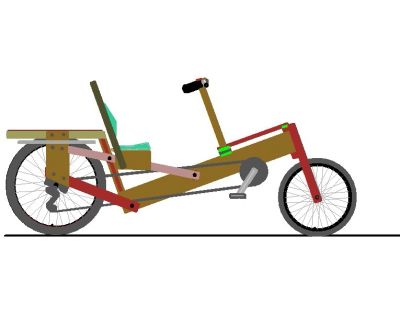
A long-wheelbase recumbent bike. Ergonomic comfort for persons with back and neck pain, shoulder/arm/hand weight-bearing issues, or those unable to endure a standard bike seat. Very competent on gravel and dirt. Not a cargo bike but fits a large pair of panniers and can carry groceries or typical touring gear. Complexity level is 'simple'. Chain-drive only. Can use purchased or owner-built crankset and wheels. Accepts 26", 29" and 700c wheels, and 26" fat tires. 

Cargo trike

Bakkie

Large capacity cargo trike. Box size, depth and width all customizable. Jackshaft creates two-wheel-drive from standard off-the-shelf bike wheels. Wide-platform fenders carry oversize loads. Complexity: 'Simple'. Chain-drive only.

Copyright © 2026 simple cycle project - All Rights Reserved.

Powered by

  • Models
  • Partnering
  • Design
  • Executive Summary

This website uses cookies.

We use cookies to analyze website traffic and optimize your website experience. By accepting our use of cookies, your data will be aggregated with all other user data.

Accept