HOW WE DESIGN

HOW SIMPLE CYCLES ARE DESIGNED
The Job of a Cycle
Simple cycles are meant to serve people in both industrialized and developing countries. Simple cycles have the same modest yet important job, no matter where they are to be found—the job of transporting you, your cargo, and your passengers---in a manner that is safe, efficient and enjoyable.
The Worth of a Cycle
When you bicycle, you travel at 4X your walking speed, without using any more energy.
A utility cycle comfortably carries 4X the weight of cargo that you might carry on your back.
A utility cycle therefore potentially represents – for those who have little other choice but to walk – as much as a 16X improvement in personal transportation capability. Especially for those persons living in deep poverty, who are carrying goods to market and commuting long distances, 16X can be utterly transformative.
We have done everything possible to make Simple cycles attainable and affordable by the hundreds of millions of persons in developing nations who realistically have almost no chance of purchasing a bike.
The Value of Muscle Power
In rural areas of developing nations, a majority of the limited calories people ingest are consumed in walking long distances and carrying substantial loads. A good utility bike can reduce this beast-of-burden energy drain by as much as 80% when operating on passable roads over rideable terrain.
In industrialized nations, where often an excess of calories is consumed relative to the minimal muscular exertion demanded of us, having a utility cycle to ride on everyday errands can provide valuable escape from the health-destroying trap of the modern sedentary lifestyle. Multiple studies from developed nations find that consistently active bike commuters may live a decade of healthy, vigorous years longer than chronically sedentary (automobile and public transport) commuters.

The Price of a Cycle
Theoretically, you could outfit your Simple cycle frame with brand new ultra-lightweight wheels and a premium multispeed transmission. Most people, however, are far more likely to build up their Simple frame with salvaged bike parts and secondhand wire-spoked wheels. If you have few financial resources at this time, and if you live hundreds of kilometers from the closest bike shop, our plans will provide you with even more options. You can outfit the cycle frame you have built with wooden wheels fabricated using our plans and pictorial instructions. You can piece together scrub brakes from old tire rubber and blocks of hardwood. You can make shifter and brake levers from nothing more than small boards with a couple of holes drilled in them.
All of these approaches result in similarly functional vehicles. You can aim anywhere on the spectrum of specifications at a point where costs are appropriate for your present budget. You will be able to upgrade over time as you wish.
ADVANTAGES OF SIMPLE CYCLE ARCHITECTURE
Modular Construction
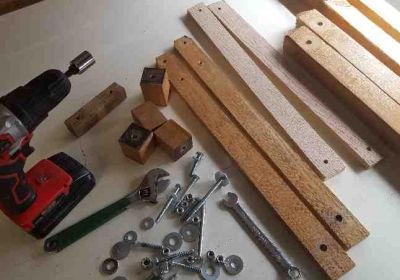
Simple cycles are modular. They are built from pre-designed pieces (“modules”) that are held together with reversible fasteners (bolts or screws), so that they can be taken apart a piece at a time for modification, repair or compact transport.
Alternatively, frames can be pegged and glued together or even nailed; pieces do not then remain ‘modular’ in the sense of ‘able-to-be-easily-disassembled’.
Highly Adaptable Architecture
If a Simple cycle needs to be resized or changed for any reason, you can unbolt it, adjust or replace one module/piece or a few, move things around as desired, add a mount almost anywhere you want, and put it back together, until it’s just the way you want it. This is fundamentally different from the inflexible configuration of monolithically-welded thin-wall metal frames and those built of composites. As an owner-builder, you don’t have to hunt down a specialized technician to modify or repair your cycle; you can make changes and repairs yourself.
You can install almost any components which you have available. We show how the frame can adapt to almost any kind of wheel and any kind of transmission. Our Plans include instructions for creating mounts for shifters and virtually any kind of brakes.
You can very straightforwardly add accessories (by screwing on a new piece, or drilling a new bolt hole), something not easily done on thin-wall metal frames and composite-construction bikes.
Overall Goals are Reinforced in the Details
Every part and subassembly has been designed and prototyped by us over multiple iterations, in a focused effort to maximize owner-buildability, to limit materials required to only those commonly available, to avoid the need for equipment-intensive machining or welding, and to do all this without compromising functionality.
lessons learned from A Half-Century of Design
Design is a process of compromise among mutually exclusive choices. This type of quandary is well represented by that old bike-builder maxim; "Cheap, durable or lightweight; choose any two." There are a great many consequential choices which the designer must make, and all must be held in mind and considered simultaneously.
Design is a process of questioning assumptions. If this process of questioning is not pursued in the concept or design stage, it will demand resolution in the prototyping stage. We proved many concepts and tested-to-destruction many prototypes over this last half century. We have trialed vehicles which hit a real sweet spot, and more than a few that had structural conflicts which could not be resolved. The moment of prototype failure has the potential to be embarrassing and sometimes injurious. Failings were often reworked to the point of acceptability; others could not be salvaged and were abandoned. The models we now offer have survived this winnowing process.
The long painstaking process of Design Development is what gives our plans their value. The alternative to investing in a set of plans grown from our decades of experience is potentially to find your self-designed cycle undependable or totally unusable, and the money and hours you have invested lost.
the value of recumbency
A noticeable departure from ordinary utility-bicycle design has been our inclusion of some models which have 'recumbent' (or 'semi-recumbent') seating. For many persons, the term 'recumbent' brings to mind very low and very reclined bikes of a solely recreational nature, but our design approach departs from this paradigm. Car-like ergonomics, car-like seat height, and traffic view and visibility made possible by taller seating and alert eyes-forward head position; all of these enhance continuous situational awareness and therefore safety in automobile/truck traffic and mixed pedestrian/cycle environments.
Recumbent seating offers ergonomically neutral and non-stressful long-distance comfort for any and every body. The very same need for continual traffic awareness combined with long distance ergonomic comfort is precisely why cars are recumbent.
A recumbent seating position greatly enhances adaptability for that large minority of persons who have mild or moderate special needs.
The lowered center of gravity enhances the stability of tricycles. The likelihood and severity of braking and impact accidents are reduced with a lowered and rearward center of gravity. Long-wheelbase recumbent cycles provide a 'crumple zone' in the event of a head-on collision. The risk of 'flying over the handlebars' is near zero.
Recumbency makes feasible integrated aerodynamic and all-weather enhancements.
Several of our cycle configurations come in either upright or recumbent versions; both will have equivalent utility and comparable performance.
You won't be able to do 'wheelies' on a recumbent. You won't be able to 'hop' a tall curb, but you will be able to smoothly push over it. You won't need to do 'track stands' while waiting for a traffic light.
Infinite Longevity
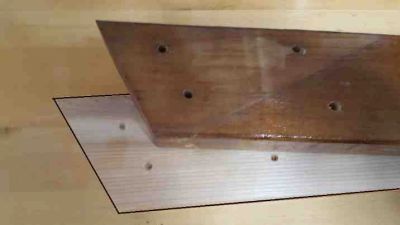
If some part of the Simple modular frame becomes damaged, you can replace that specific part; you don’t have to throw away a whole frame. Just ‘trace-and-replace’ the broken part’s outlne onto a board of appropriate thickness, transfer hole locations, apply weather resistant finish as needed, and install.
You can dismount and replace any worn-out component.
Your Simple cycle may well have an infinite working life. Thirty years from now, it is conceivable that every single original piece will have been replaced at least once, but your expectation can be that the cycle will never have stopped functioning for more than a few hours or days at a time.
Wide Material Choice
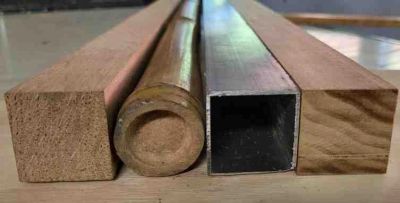
Simple Cycle modularity lets you choose from:
- naturally-beautiful carbon-sequestering hardwood or softwood boards (sawn from small-diameter logs);
- unprocessed ‘pre-commercial’ (very-small-diameter trees thinned from over-crowded stands) round-wood that is hand-hewn to create one flat side;
- fast-growing ‘timber type’ bamboo (with painting or treatment to prevent mold, insect damage, and checking/splitting;
- fully-recyclable and maintenance-free aluminum (with steps taken to prevent galvanic corrosion);
- a mix of these materials.
Any and all of these can make up the elements of a robust and moderate-weight frame.
Materials can be rough or refined.
If the wood you have available to you is of lower quality, you can use the techniques described in the Fabrication document to improve the workability and functionality of imperfect boards.
Bamboo has great potential as a rapidly-renewable resource, with several qualities that make it structurally appropriate for cycle frames. Timber bamboo is not native nor widely grown in North America, consequently, we have had limited experience with its fabrication. Regions where bamboo grows have well-developed methodologies of preservation, fabrication and construction, and we are planning to learn there from the masters. We are working to prove beginner-buildable bamboo versions of select Simple models. These will be functional designs that achieve much more than merely cloaking the complexities of metal construction under an attractive veneer of natural material.
Wood is a renewable material highly appropriate for the construction of small lightweight vehicles. The trees and forests which provide this material are essential to ecosystem health, and history warns us of the ease and speed with which forests can be over exploited. For a deeper look at the history and potential of timber, and Simple Cycle Project's place within it, see the Resource Demand page.

all-weather operation
All Simple cycles need to operate dependably in poor conditions. Cargo and passengers may require protection from rain, sun or cold. Traction needs to be adequate for marginal roads and muddy or icy trail surfaces. Accessories for enhancing foul-weather operation need to be easily mounted and actuated. Models and options made specifically for extreme conditions need to be tested and proven. Link here for an overview.
Wide Component Choice
The modular Simple cycle is designed to accommodate virtually any wheels, any transmission and any components. Whatever bike components may be available to you almost certainly can be installed on your frame. Alternatively, the Plans show how you can build virtually every piece and component from scratch.
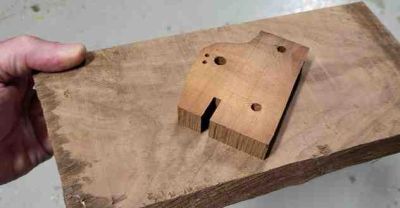
As an example, shown here is one of a pair of mounting plates for Vee or Cantilever rim brakes (appropriate for wheels that have metal rims), along with a hardwood board from which the plates were cut. The Plans give dimensions for mapping out and marking the holes to be drilled. After they are drilled, the identical/mirror pair of finished mounting plates are clamped one onto each side of the front fork or rear stays, in the position indicated in the Plans. Bolt hole positions in the plate are then transferred to the frame or fork using a pencil, nail or drill bit. This method is beginner-buildable, sturdy and functional.
Transmissions
Because the transmission of a modern bike (metal crankset, bottom bracket and bearings, drive sprocket, driven sprocket, chain) is the most complex, expensive, difficult-to-obtain and difficult-to-install subassembly of a bike, we are creating designs for less costly, fully-owner-buildable options.
Kick-bikes and push-bikes do not have transmissions.
Linkage-drive transmissions were used on the first generation of pedal-bikes back in the 1840’s. These limited speeds (on standard diameter wheels) to 8 miles/12 kilometers per hour or so (jogging speed), as a linkage drive (unavoidably-single-speed) still does today. Functional linkage-drives were used on a number of bicycle models in the half century of bike experimentation which ended in the 1890’s when the higher-cost chain-drive ‘safety bike’ was introduced.
Our Simple version of linkage-drive (illustrated here) is readily owner-buildable, and for some people may serve until such time as a crankset and chain can be afforded and retrofitted. For utility handcycles – designed to travel at walking speed – the inherently low gearing of an arm-powered linkage drive may have no disadvantage.
Metal toothed sprockets/chainrings can be bolted onto the wooden hub of a wooden Simple wheel, and a metal sprocket/chainring can be bolted onto a wooden Simple crankset; add a matching chain and you then have a fixed-gear drive with the gear ratio of your choosing. Sprockets and matching chain can be of bicycle type or motorcycle weight; any chain will be installed in the same fashion and adjusted in the same manner.
Chains: If your chain breaks or a bike cog wears out, you can likely find a replacement in most cities or larger towns of the world. There is an exception to this: If you decide to use bicycle multi-speed sprockets and chain, such as a modern 10, 11 or 12-speed 1X group-set, very many bike shops in developing countries do not yet carry parts for these systems. Such chains are narrow and are not interchangeable with wider old-style bike chains. They are also pricey and available only new, not secondhand. If you’re wanting a multi-speed chain drive which will make finding parts as easy as possible, then an 8-speed cluster and matching chain are your best bet, as these are most widely available. A multi-speed chain and sprocket can also be used to build a single-speed transmission.
Compactibility
Modularity/removability means you can take your bolted-together cycle entirely apart and pack it, section-by-section or piece-by-piece, for compact shipping, or for long-distance bus, boat or train travel.
Balancing Weight, Efficiency and Strength
Most Simple models are of moderate weight, roughly comparable to steel-tube bicycles. Almost all of the two-wheel Simple models are thus efficient enough to serve the daily commuter or touring cyclist. Most Simple models can be propelled even by the strength of a middle-school child.
The Simple cycle uses reversible fasteners (ordinary moderate-cost bolts or screws) to achieve structural strength with minimal weight, and to allow disassembly, customization and repair.
Power Assist
Simple cycles are designed first and foremost for efficient use of human muscle power. They are designed secondarily to accommodate virtually any after-market power-assist. Electric motors and wheel hubs that put out 1000 watts or less should generally integrate well into the cycle's structure without need for major frame modification or reinforcement.
Many Simple models have design attributes that facilitate the inclusion of on-board photovoltaic solar modules. On-board electrical generation creates significant range extension or potentially even full energy self-sufficiency. Canopies that generate a moderate amount of power and also provide shade for the operator can be installed on virtually all Simple recumbent bikes and trikes.
Disadvantages of simple cycle
DISADVANTAGES OF SIMPLE CYCLES
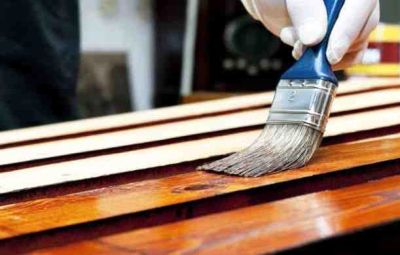
Unprotected wood ages in the sun and rain, so you need to put attention and effort into doing a good initial job of sealing or painting the wooden frame pieces. Parking the bike out of the weather when it is not being ridden is also advised, as is taking time to touch up the weather-resistant finish once or twice a year.
Neglected unlubricated chains can get rusty, stiff, noisy and inefficient. If your model has a chain, you will need to regularly wipe it clean and then lubricate it, preferably with "dry lube" (containing silicone or graphite) if riding in dusty conditions, or with "wet lube" if riding in rain, snow or mud. Oil and grease collect dirt and leave smears on legs, pants or dresses, so are a last resort. Wax or wax-based lubricants are clean and work well across a wide range of conditions.
You may fail to ensure that all your bolts are tight, and loose parts will call for your attention with sad little squeakings. Squeaks, if neglected, turn into squawks. The unwanted attention of judgmental people and amorous parrots will be drawn to a squawking bike. Persistent squeaks can be silenced with screws and glue.
No matter how expedient it might seem in the moment, do not leave a cycle made of wood leaned against a termite mound or beaver lodge.
Do not leave your cycle within reach of circus bears and orangutans. Our furry cousins are not as competent at riding a bicycle as folk tales suggest, and a crash could be disastrous. Large, hairy non-humans—and their lawyers—should not be provoked.
If you must have the latest high-tech feather-weight racing bike, this is not the cycle for you.