Experience Cycling like Never Before

all-weather protection
Regions that experience extreme weather demand that steps be taken to protect riders, passengers and cargo from inclement conditions. If your cycle is your primary form of transportation, you need to be able to rely on it even if a storm comes up. Unlike recreationists, you cannot afford to be a 'fair-weather-only' rider.
multifunctional canopy
Riders who regularly experience long hours of intense sun can protect themselves from overheating on the road by installing an overhead canopy. This same canopy, with appropriate materials, can serve to shed rain. The canopy can also serve as a support for a solar photovoltaic module. The multifunctional canopy design at this time is not yet standardized. Mounting systems will be configured for both recumbent (bike and trike) and upright (trike) models. Convertibility features are yet to be optimized.
Experience Cycling like Never Before
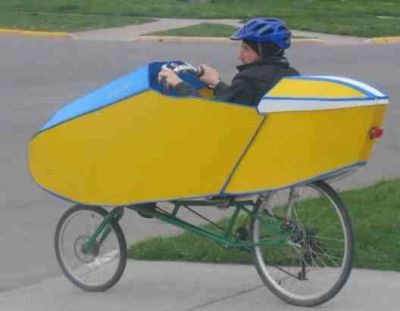
r&d: aerojacket
Riders of the Roxy recumbent bike and the Greenway recumbent trike who live in regions which seasonally experience near-freezing or sub-freezing temperatures, or which experience frequent and prolonged cool and rainy weather, can maximize their comfort and extend their cycling season by building and installing an Aerojacket.
This is not a sleek, rounded, refined streamliner shell of the sort used to break speed records. It is instead utilitarian to the max and as low-cost as practicable. Its hard-chine flat-panel construction achieves modestly enhanced speed, acceptable side-wind stability, and ease-of-build by virtue of its no-compound-curves, modified-Steinmetz-body geometry.
Strong riders will enjoy noticeably higher cruising speeds any time they exceed 15kph/10mph, the point at which "wind resistance" begins to compound and aerodynamic advantage really begins to pay for itself. Slower riders will enjoy the aerodynamic efficiency benefits of an Aerojacket anytime when riding into headwinds.
Aerojackets are designed to integrate multifunctional canopies (not shown).
We have built a handful of prototypes, but do not have Plans updated at this time. The main challenge for continued development has been the sourcing of a lightweight, durable, recyclable and affordable sheet-stock from which to cut panels, a material which is widely available in all markets. At this time, all panels we have used are available only in industrialized economies.
Experience Cycling like Never Before

r&d: solarwind
The multifunctional all-weather Solarwind trailer design combines structure that supports a photovoltaic solar array together with the framework of a pop-up camper. While folded down and traveling it will present a low and highly streamlined profile. When popped-up at camp it will take the form of an A-frame hard-sided shelter.
Building the Solarwind will not be a low-cost project.
The Solarwind is in the concept stage of Research and Development. We have not yet built the vehicle described here. We introduce the concept now because it promises to fill a major technology and performance gap in the cyclotouring world. We are familiar with each of the various sub-systems and materials that it utilizes. We have established the weight of materials but have not confirmed that the simplest and lightest structure envisioned will have the stiffness required. We are confident that it will perform overall as we predict. We are less confident that its folding mechanisms will immediately perform flawlessly. We know that, as with all product development, some initial design details will need improvement. A couple of prototype generations will be required.
When in motion, the solar array will lie horizontally, providing power when the sun is high in the sky, and achieving this regardless of direction of travel. When parked and popped up, the tilted array can be easily aimed at the sun for maximum battery charging while camping.
The pop-up/fold-down form of the low-profile Solarwind avoids the very substantial aerodynamic drag of a boxy caravan. If you are traveling with a bike camper/caravan across the Great Plains of North America, the Kazakhstan steppe or the Nullarbor, you eventually will have to deal with strong and implacable headwinds which can bring progress to a crawl and a cyclist to tears. The Solarwind is designed for those times.
Virtually any type of cycle can pull the Solarwind trailer. Solar electric power can be routed to charge batteries on a towing electric cycle. Alternatively, power can be used to charge the batteries of a power system that is fully self-contained within what then becomes a self-propelled trailer. Self-propelling is achieved with either hub motor(s) or chain-drive. Certain battery management systems do not permit solar charging; identify this restriction in advance.
On the narrow/1-person/bike-lane-width version, the photovoltaic array has room for 300 peak watts of pv modules. PV is not inexpensive. The materials specified for the body/shell are available in industrialized economies; they also are not cheap. This vehicle will be owner-buildable, though a level more challenging than our 'simpler' and 'simplest' cycles.
Experience Cycling like Never Before
r&d: flotation
Many regions confront seasonal flooding. We have applied to the lessons learned during our several historical forays into amphibian operation to the creation of a Simple-specific owner-buildable flotation system made from local and waste materials.
Plans are in the early stage of development. Flotation volumes have been measured and load limits estimated. Attachment points for flotation have been identified on each Simple model. Clearance requirements and stability under load have been established. Methods of propulsion have progressed through initial proof of concept. All waters in which we have operated satisfactorily have been still or very slow moving; this will in most models remain the limit to safe operation.